The State Will Close New York City's Budget Gap
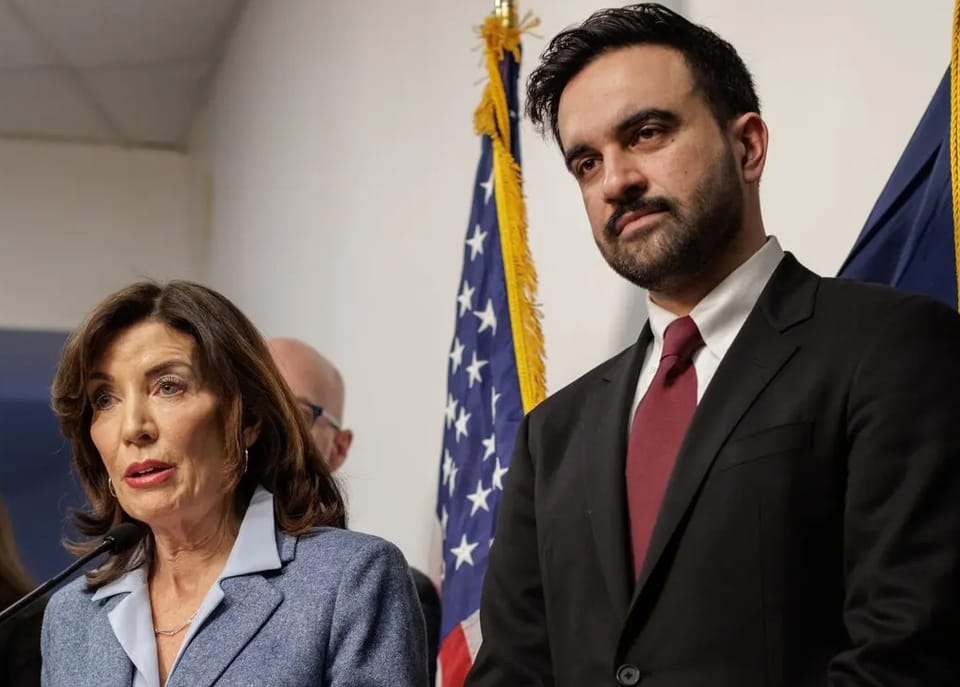
The budget battle between the state and the city is over.
Mayor Mamdani revealed that Governor Kathy Hochul and the state legislature will give New York City $4 billion to close the gap in its FY2027 budget.
"I am thankful for her collaboration and deep commitment to securing a future for our city that working people can afford,” said Mamdani in the press release.
The agreement comes after the mayor pressured the governor to help fund the city's budget in a variety of ways.
First, Mamdani established that there was a $12 billion deficit created by his predecessor.
"In the words of the Jackson 5, it's as easy as A-B-C. This is the Adams Budget Crisis," he said at a press conference January 28, 2026 in reference to former mayor Eric Adams.
Adams underestimated billions in city costs, causing a wide deficit, according to Mamdani.
The gap narrowed to $5.4 billion by mid-February after the release of the mayor's preliminary budget. Savings, an upward revision of tax revenue, and state support narrowed the deficit.
The ball entered the city council's court. After every budgeted department in the city testified throughout the month of March on how much more funding they needed, how much they were spending, and how they could fulfill the mayor's call for affordability, Speaker Julie Menin and the council came back with a response.
On April Fools' Day, while city departments were posting satirical videos on TikTok and Instagram, the mayor disapproved of the speaker and council's budget in a press statement, claiming it perpetuated long-time divisions between the city and state, and the rich and the poor.
"It effectively ensures this structural deficit will continue indefinitely," said Mamdani.
One way to fill the remaining $5.4 billion gap soon followed in the Hochul-approved pied-a-tierre tax, a tax on second homes that would generate another $1 billion for the city.
Then, the mayor and the speaker joined forces to propose lowering the PTET, a tax break members of certain corporations get when the corporation pays a similar tax, giving the city another $1 billion. The idea needed state support and was immediately struck down by the governor.
But both Mamdani and Menin argued that the state was not doing enough for the city.
New York City generates more than 55% of the state's revenue, but only receives 42% back, the leaders pointed-out at an April 29 press conference.
"That gap is not sustainable," said Mamdani.
Today's announcement to close the gap with an additional $4 billion from the state to the city, achieves Mamdani's goal of filling the deficit left by Adams, but without the class-focused shift the mayor wanted.
Hochul, who refused a change to the PTET, and Menin, who refused to raise property taxes on wealthier New Yorkers, both agreed on the pied-a-tierre tax that makes up the other $1 billion.
"If you can afford a $5 million second home that sits empty most of the year, you can afford to contribute like every other New Yorker,” said Hochul.
Help keep it that way.